Container : Mirror Matrix Diagram
Project Introduction
This diagram is inspired by a Tang Dynasty Daoist copper mirror, designed by Sima Chengzhen (647-735 AD). It represents a sacred microcosm, embodying the primordial Qi. The outer edge of the mirror is adorned with the sun, moon and constellations, while the center features nested squares. Within the squares are 16 pictographic characters that, when read in an encoded sequence, form meaningful sentences. This layout was a standard format circulated at the time.
According to the mirror’s inscription, the reading sequence begins with the four characters on the outermost ring. For the second round, the mirror is rotated counterclockwise to read the fifth to eighth characters, and so forth, creating a spiraling inward movement of the viewer’s gaze.
I simplify this matrix model as a conceptual framework to encompass both analog and digital technologies, synthesizing sound and image sources. Using the matrix diagram, I visualize compositions through intuitive strategies. It helps me articulate ideas, and uncover many unexplored paths.
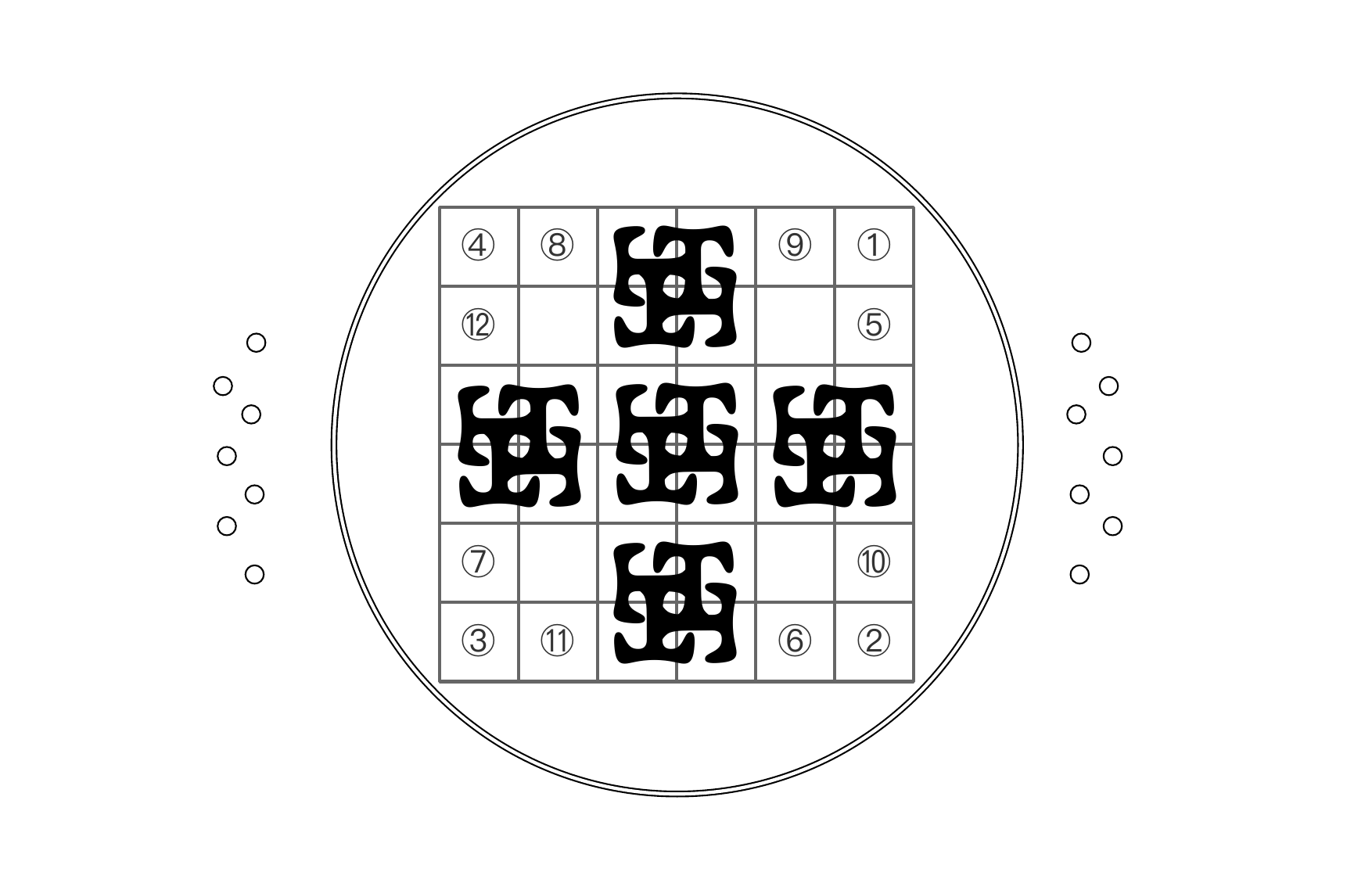
Container : Mirror Matrix Diagram
Multimedia / Digital illustration, 2024 — Ongoing
The Typeface “ T ” is Basteleur Moonlight from Velvetyne, a repository of open source and/or libre typefaces
For me, it serves as an assemblage for navigating the material preparation stage, emphasizing the significance of a multi-layered classification system. It is a re-structures of different compositional models of sound and image. Through analogical perception, I can map surrounding materials as different elements, including various types of events and parameters in digital interfaces, and find the potential syntactic structure behind them. It acts as an anchor point for collecting individual symbolic meanings.
The conceptual foundation of this matrix is rooted in the symbolic system of the Chinese divination tradition, highlighting the mediating role of symbols:
“Symbolic system and its formal symbols ↔ Encoding systems ↔ Networks or pathways of dissemination ↔ Materials, carriers, and interfaces.”
As McLuhan posits, the concepts of technology and media are inherently ambiguous, since any technology can be regarded as a prosthesis.
Thus, the medium can be defined through the technological extension of the body, which, in turn, can be identified through the invention of prostheses. The extension of the body becomes an extension of concepts, which can be historically concretized, integrating premodern cultural resources. Within this integrative framework, formless forces are distributed.
In my vision, this matrix can also be applied to explore the space of rituals and aesthetic practices. It investigates cooperative spatial actions facilitated by objects such as maps, cosmograms, ethnic masks, shamanic drums, and other tools in the continuum from instruments to vessels to media. By expanding the matrix, intuition can be renewed.
This research transforms Lothar Ledderose’s theory of Chinese modular technology, particularly its manifestation in Bronze Age ritual vessels, into a contemporary media oracle.